Who’s Paying for the AI Boom? Data Centers, Electricity Costs, and the Fight for Ratepayer Protections
Abstract
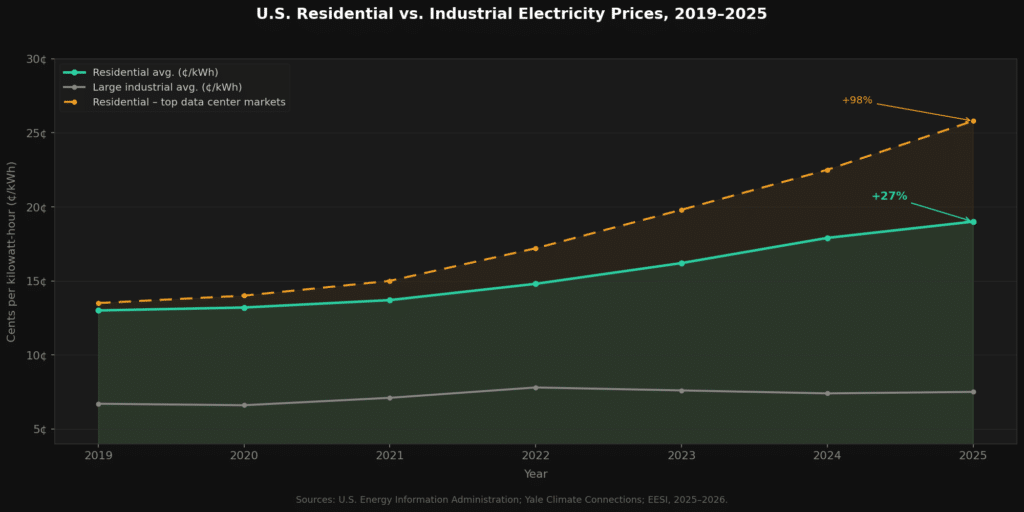
American residential electricity prices rose 27% between 2019 and 2025 while data centers paid dramatically lower rates. This paper examines the structural mechanisms transferring data center infrastructure costs to residential ratepayers, evaluates federal, state, and local policy responses, and provides a comprehensive framework for municipal data center ordinances — the most immediate tool available to communities seeking protection now.
Executive Summary
Before 2019, average U.S. residential electricity prices had been essentially flat for more than a decade, hovering around 13 cents per kilowatt-hour. By the end of 2025, that figure had climbed to 19 cents per kilowatt-hour — a 27% increase in six years, substantially outpacing general inflation. Residential customers saw prices rise another 11.5% in 2025 alone. Meanwhile, large industrial electricity users — including data centers — have seen their rates increase at a fraction of that pace, with some industrial customers paying as little as 8 cents per kilowatt-hour: less than half of what a household pays for the same energy. The mechanism behind this asymmetry is not accidental. It is structural.
Data centers consume electricity at an industrial scale — some hyperscale facilities require as much power as a mid-sized city — and the infrastructure required to serve them must be financed. Under the century-old cost-socialization model that governs most American utilities, those infrastructure costs are spread across all ratepayers. That means every household in a utility’s service territory is, in effect, helping to subsidize the grid expansion that Amazon, Meta, Google, and Microsoft require to run their servers. Utilities requested a record $31 billion in rate increases in 2025, more than double the amount requested in 2024. The Edison Electric Institute projects its member utilities will spend $1.1 trillion in capital from 2025 through 2029. In the PJM region alone — which includes Virginia’s “Data Center Alley,” the largest data center market on Earth — residential and commercial customers paid $4.4 billion in data center-related transmission costs in 2024.
At the federal level, seven major technology companies signed President Trump’s nonbinding “Ratepayer Protection Pledge” on March 4, 2026. Across state legislatures, more than 300 bills addressing data center energy policy had been introduced in over 30 states in just the first six weeks of 2026. These are meaningful signals. But a voluntary pledge carries no enforcement mechanism, and even enacted state laws have already faced challenges from utilities seeking to pass costs to consumers in creative ways. The municipal level — local governments using zoning and land use authority — represents an underutilized but critically important tool for communities that need protection now, before state legislation catches up.
Table of Contents
Section 1: The Data Center Demand Surge — Scale, Speed, and Concentration
Section 2: Two Mechanisms of Cost Transfer — How Data Centers Raise Your Bill
2.1 Infrastructure Socialization
2.2 Wholesale Market Price Effects
Section 3: Who Bears the Burden — Disparities Across Income, Region, and Customer Class
Section 4: Protective Measures — What Has Been Put in Place
4.1 Federal Actions: The Ratepayer Protection Pledge and Legislative Proposals
4.2 State-Level Legislative Response: A 50-State Scramble
4.3 Utility-Level Responses: Rate Classes and Long-Term Contracts
Section 5: Where Current Protections Fall Short — The Enforcement Gap
Section 6: The Municipal Lever — What Data Center Ordinances Can and Cannot Do
6.1 The Scope and Limits of Local Authority
6.2 Core Components of a Strong Data Center Ordinance
6.3 Energy Infrastructure Provisions: The Most Critical Local Tool
6.4 Real-World Ordinance Models Worth Studying
Section 7: Why This Matters
Section 8: Key Takeaways
Sources
Section 1: The Data Center Demand Surge — Scale, Speed, and Concentration
The numbers attached to data center power consumption have become almost impossible to contextualize without hyperbole. Virginia — the state that coined the term “Data Center Alley” for the stretch of Loudoun County highway lined with server farms — currently hosts nearly 600 data center facilities, with more than 100 additional projects proposed or under construction as of early 2026. In 2024, data centers accounted for approximately 40 percent of Virginia’s total electricity consumption. Across the country, these facilities consumed more electricity in 2024 than many mid-sized nations.
The Lawrence Berkeley National Laboratory projects that data centers could account for 12 percent of all electricity consumed in the United States by 2028. In 2025, dozens of utilities received requests to connect data centers representing more than 700 gigawatts of new power capacity — a figure exceeding the 477 gigawatts of electricity the entire United States consumed in 2023. The scale of the incoming interconnection queue has no historical precedent, and utility infrastructure planning cycles were not designed to accommodate it.
The AI revolution is the primary accelerant. Training and running large language models requires orders of magnitude more computational power than earlier generations of internet infrastructure. Where a streaming video company might run its workload on a few hundred megawatts, hyperscale AI campuses are now being designed for gigawatt-scale power delivery. Dominion Energy Virginia — the largest utility in the country’s most data-center-dense state — projects that data center metered load will reach 13,353 megawatts in its service territory by 2038, a 3.5x increase from the level it manages today. That single utility’s data center load is currently larger than the total electricity consumption of several U.S. states.
[PLACEHOLDER — DATA CALLOUT BLOCK]
700 GW — Data center interconnection requests received by U.S. utilities in 2025
~40% — Share of Virginia’s total electricity consumed by data centers in 2024
12% — Projected U.S. electricity share for data centers by 2028 (Lawrence Berkeley National Laboratory)
$31B — Utility rate increase requests filed in the U.S. in 2025 — more than double 2024
Section 2: Two Mechanisms of Cost Transfer — How Data Centers Raise Your Bill
The pathway from a server farm’s power draw to a family’s monthly electricity bill is not intuitive. It does not involve a direct surcharge or a line-item fee. It works through two structural mechanisms built into the foundational architecture of how American utilities operate, and understanding them is essential to evaluating any proposed remedy.
2.1 Infrastructure Socialization: The Century-Old Cost-Spreading Model
When a utility builds infrastructure — a power plant, a transmission line, a substation, a transformer — it recovers the capital cost through rates charged to all of its customers. This arrangement has governed American electricity since the beginning of the industry, and for most of its history it was broadly defensible. The infrastructure costs associated with, say, a downed power line in one neighborhood were modest relative to the shared benefit of universal service, and spreading them across the rate base made reasonable sense. The data center era has broken this logic.
A hyperscale data center requiring 500 megawatts of new power capacity may necessitate an entirely new substation, miles of high-voltage transmission lines, and additional generation capacity — capital expenditures that can run into the billions of dollars. Under traditional utility rate-setting, a significant portion of those costs flows into the rate base and is recovered from all customers in the utility’s territory, regardless of whether those customers benefit at all from the new facility. As Ari Peskoe, an energy law scholar at Harvard Law School, has described the problem: utilities building billions of dollars of new infrastructure solely to serve data centers are spreading those costs to ratepayers who have no relationship to the technology companies being served.
Rate cases — the proceedings before state public utility commissions that set customer prices — have two steps. The first determines the total revenue the utility is entitled to collect; the second determines how that revenue is allocated across customer classes. For most of the industry’s history, the cost-causation principle guided the second step: customers pay in rough proportion to the costs their consumption patterns impose. Data centers have stressed that principle to the breaking point. Their consumption is enormous, relentlessly constant (they run 24 hours a day), and concentrated at specific high-voltage interconnection points that require custom infrastructure. Yet in many jurisdictions, they have continued to pay rates closer to those charged to other large commercial customers, with the extraordinary incremental infrastructure costs distributed across the residential class.
2.2 Wholesale Market Price Effects: Supply, Demand, and the Grid’s Bid Stack
The second mechanism operates through electricity markets rather than rate cases. In regions where utilities purchase power through competitive wholesale markets — which includes most of the northeastern United States through the PJM Interconnection — electricity prices reflect supply and demand conditions in real time. As data centers add enormous quantities of constant, always-on load to these markets, they push demand higher without a commensurate short-term increase in generating capacity. Power plants take years to site, permit, and build. The gap between a rising demand curve and a slow-to-respond supply curve manifests as higher market-clearing prices, which utilities then pass to all customers.
A Bloomberg News analysis found that wholesale electricity prices rose as much as 267 percent over a five-year period at grid pricing nodes near significant data center activity. PJM’s capacity market — which compensates power generators for being available to meet peak demand — has experienced particularly dramatic price increases: a capacity auction that cleared at a modest price in 2024 escalated 860 percent to $269.92 per megawatt-day the following year, and the December 2025 auction reached the regulatory price cap of $333 per megawatt-day without securing sufficient capacity to guarantee reliability. These capacity costs are passed through directly to utility customers. PJM customers in seven states paid $4.4 billion in data center-related transmission costs in 2024 alone.
“The utility is going to have to build a lot of new infrastructure to be able to generate power and deliver that power. Everyone is going to bear some of that cost. Because data centers consume so much power, the traditional approach of spreading infrastructure costs across all ratepayers forces us to pay for costs that the utility incurs only because of the computing facilities.”
Ari Peskoe, Energy Law Scholar, Harvard Law School
Section 3: Who Bears the Burden — Disparities Across Income, Region, and Customer Class
Rising electricity costs are not distributionally neutral. The burden of higher utility bills falls with dramatically unequal weight depending on household income, geography, and the specific utility and state in which a customer lives. Before the data center construction surge even began reshaping demand patterns, one in four American households was already reporting difficulty affording energy bills or maintaining safe indoor temperatures due to energy costs. The data center era has worsened these conditions at a time when households have the least capacity to absorb additional costs.
Low-income households, renters, and Black and Hispanic families spend a disproportionate share of their income on energy — some up to 20 percent of household income, compared to approximately 3 percent for higher-income households. This energy burden makes utility price increases qualitatively different from other cost-of-living pressures: the same ten-dollar increase in a monthly bill is trivial for a household earning $200,000 per year and a genuine crisis for a household earning $30,000. By June 2025, outstanding utility bill debt for U.S. households had reached $25 billion — up from approximately $15 billion in early 2022. Utility shutoffs reached 3.5 million in 2024 and may have approached 4 million in 2025.
The regional dimension of this burden is equally stark. States and metro areas where data centers are heavily concentrated have experienced the sharpest residential price increases. New Jersey, which lies within the PJM service territory that includes the densest data center markets on the East Coast, saw average electric bills surge more than 20 percent in 2025 alone. In Georgia, where data center development has accelerated significantly, November 2025 elections saw two incumbent public utility commissioners defeated in part on the strength of constituent anger over a 41-percent residential electricity price increase over four years.
The rate-setting asymmetry compounds the geographic disparities. In Oregon, large industrial users were paying approximately 8 cents per kilowatt-hour while residential customers were charged more than double that rate — 19.6 cents per kilowatt-hour — for the same electrons. This is not a product of residential customers using more expensive infrastructure; it reflects rate structures designed in an era when industrial load growth and residential load growth were roughly correlated, meaning infrastructure costs were somewhat equitably shared. Data centers have shattered that correlation by generating industrial-scale load growth that serves no residential purpose.
[PLACEHOLDER — DATA CALLOUT BLOCK]
20% — Energy as share of income for low-income households — vs. 3% for higher-income households
$25B — Total U.S. household utility bill debt as of June 2025
3.5M — Utility shutoffs in the U.S. in 2024 — rising toward 4 million in 2025
41% — Georgia residential electricity price increase over 4 years, contributing to November 2025 utility commission election defeats
Section 4: Protective Measures — What Has Been Put in Place
The political response to data center-driven electricity cost increases has been bipartisan, geographically broad, and — in 2025 and 2026 — remarkably rapid. Measures at the federal, state, and utility levels represent genuine progress, even if none of them individually resolves the underlying structural problem.
4.1 Federal Actions: The Ratepayer Protection Pledge and Legislative Proposals
The most prominent federal action to date is the Ratepayer Protection Pledge signed at the White House on March 4, 2026. Under the pledge, seven major technology companies — Amazon, Google, Meta, Microsoft, OpenAI, Oracle, and Elon Musk’s xAI — committed to “build, bring, or buy” new generation resources to meet their data centers’ energy requirements; to pay the full cost of any new grid infrastructure required to serve their facilities; to negotiate separate rate structures with utilities and state governments; and to invest in local workforce development. President Trump issued a formal proclamation that same day establishing the Ratepayer Protection Pledge as national policy. On March 20, 2026, the Trump administration’s National Policy Framework for Artificial Intelligence called on Congress to codify the pledge into law.
Separately, Representative Mike Levin introduced the SHIELD Act in the House of Representatives, which would update federal utility policy to require massive electricity users — rather than everyday ratepayers — to bear the costs of grid infrastructure upgrades driven by their demand. The bill would also create incentives for large-load facilities to power their operations with zero-emission electricity. In the appropriations process, Representative Alexandria Ocasio-Cortez included a request to study data center impacts on utility bills in the FY26 Energy and Water Appropriations Act.
4.2 State-Level Legislative Response: A 50-State Scramble
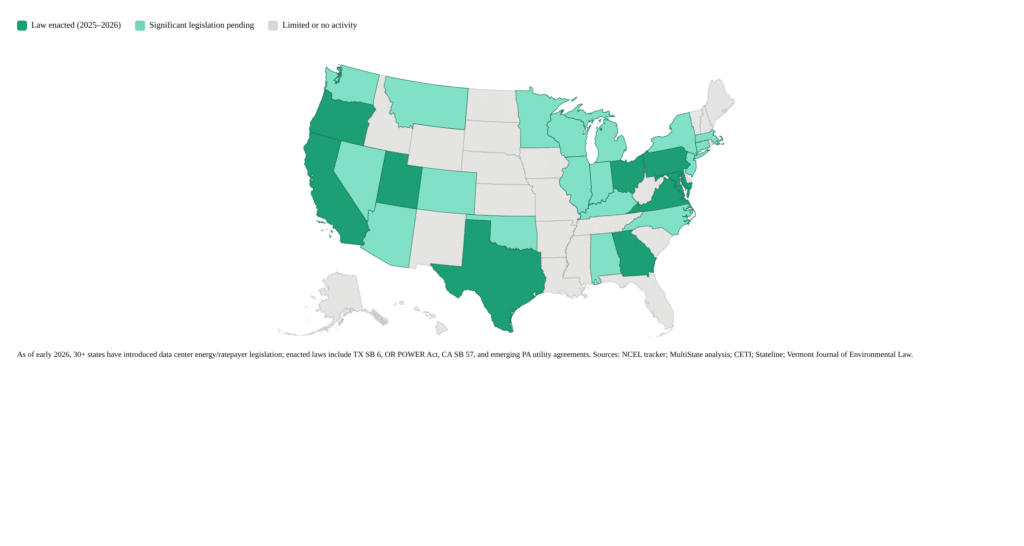
The more consequential near-term action has been at the state level. By the first six weeks of 2026, more than 300 data center-related bills had been introduced in over 30 states — following a 2025 in which at least 22 states introduced more than 60 bills focused primarily on ratepayer protection. The breadth and pace of this legislative activity reflects a rare moment of bipartisan agreement: rising utility bills are one of the most salient issues facing state lawmakers of both parties.
Several enacted laws represent meaningful models. Texas SB 6, signed in July 2025, mandated a reevaluation of existing cost-allocation methodologies and required new large loads to contribute to grid upgrades implemented to serve them. Oregon’s POWER Act, enacted in 2025, created an entirely new customer rate class for large energy users, required long-term contracts of at least ten years, and directed state regulators to separate data center costs from other ratepayers. California Governor Gavin Newsom signed Senate Bill 57, directing the California Public Utilities Commission to assess how costs associated with new data center loads should be allocated. In Georgia, the Public Service Commission unanimously approved rules in January 2025 requiring data centers to fund the full upstream generation, transmission, and distribution costs of serving their facilities — not merely their metered consumption. Pennsylvania utility PPL reached a rate case settlement in early 2026 that created an entirely new customer rate class for high-load data centers — the first time a Pennsylvania utility had formally shielded residential customers from data center costs — and established protections against stranded-cost liability if a planned facility is never completed.
Ohio took a different approach, requiring data centers to pay penalties if they commit to consuming a specified amount of electricity and fail to do so — addressing the “phantom load” problem where utilities build infrastructure for data centers that are never built or never reach projected consumption. Virginia’s Dominion Energy proposed a 14-year contract requirement for large load customers, with exit fees and minimum capacity payments to protect other ratepayers from stranded infrastructure costs.
At least 18 states have introduced bills in 2026 creating special rate classes for large energy users, with many requiring data centers to fund infrastructure improvements and demonstrate benefits to the broader ratepayer base before receiving connection approvals. Alabama’s SB 270 goes further, directing its Public Service Commission to condition permits for large load customers on a finding that the development is beneficial for ratepayers statewide.
4.3 Utility-Level Responses: Rate Classes and Long-Term Contracts
Some utilities had begun developing separate large-load tariffs before legislative pressure compelled it. These tariffs typically include minimum billing provisions, demand charges, separate rate schedules, and contract terms requiring advance notice for curtailment. Industry observers note that many established data center markets — where utilities had more time to develop appropriate rate structures — already had large-load tariffs with these features in place before the current legislative wave.
Utility-level action, however, has been uneven. The same system incentives that encouraged utilities to attract data center load — which generates substantial revenue — can work against rigorous cost allocation once those facilities are built. Utilities that have invested in infrastructure specifically to attract large data center customers have an institutional interest in not assigning the full cost of that infrastructure to those customers, lest they choose to locate in a competing jurisdiction. This competitive dynamic creates downward pressure on cost allocation rigor and must be understood as a structural constraint on voluntary utility action.
Section 5: Where Current Protections Fall Short — The Enforcement Gap
The volume of protective activity at the federal and state levels is impressive. The practical impact, to date, is more limited. Several structural gaps undermine the protective effect of even well-intentioned measures.
The Ratepayer Protection Pledge carries no enforcement mechanism. It is a voluntary commitment by seven companies to a set of principles. It covers only the seven signatories and does not apply to the hundreds of data center developers and operators who did not sign. It does not apply to existing data centers — only to new development. And critically, it does not actually bind utilities, which are the legal entities that set electricity rates. As Ari Peskoe of Harvard Law School has observed, tech companies signing a pledge does not change the fact that “utilities hold the pen on these issues, and utility regulators make the final decisions.” The rate-setting authority that determines how infrastructure costs are allocated sits with state public utility commissions, not with data center operators.
State-level laws face their own challenges. Oregon’s POWER Act, one of the most comprehensive state ratepayer protection laws enacted in 2025, was almost immediately tested when Portland General Electric — the state’s largest utility — was accused by consumer advocates of structuring a pending rate case in ways that effectively shifted long-term data center costs back to residential customers, skirting the intent of the new law. This case illustrates a pattern: well-designed statutes can be undermined by the technical complexity of rate cases, in which the burden of identifying cost-shifting falls on consumer advocates who may lack the resources to challenge every regulatory filing.
The federal legislative landscape remains unsettled. The SHIELD Act has not been enacted. The Trump administration’s call to codify the Ratepayer Protection Pledge into law faces a complex congressional calendar. Meanwhile, the administration has simultaneously streamlined environmental review for data center infrastructure through executive order, accelerating development in advance of any binding consumer protection framework. Coal plant retirements are being delayed — at an average refurbishment cost of up to $1.3 billion for aging facilities — to meet data center demand, with those costs flowing into utility rate bases.
Perhaps the most fundamental gap is transparency. Dominion Energy Virginia, the primary utility in the world’s largest data center market, differs significantly from most other utilities in how it reports data center load. The lack of standardized, timely public disclosure of data center energy consumption, interconnection requests, and associated infrastructure costs makes it difficult for regulators, policymakers, and consumer advocates to accurately quantify the ratepayer impact — or to design remedies proportionate to the actual burden.
“The Ratepayer Protection Pledge appears to be an unenforceable corporate commitment. Utilities hold the pen on these issues, and utility regulators make the final decisions.”
Ari Peskoe, Energy Law Scholar, Harvard Law School, March 2026
Section 6: The Municipal Lever — What Data Center Ordinances Can and Cannot Do
Municipalities occupy a peculiar position in the data center regulatory landscape. They generally lack authority over electricity rate-setting — that is a state and federal matter — but they possess robust authority over land use: where facilities can be built, how large they can be, what they must study before groundbreaking, what infrastructure they must demonstrate is available, and what conditions they must satisfy to receive local approvals. In the absence of adequate state and federal protection, thoughtful local ordinances represent the most immediate tool available to communities facing rapid data center development.
The stakes are real and the urgency is genuine. Many municipalities have found themselves with no data center-specific zoning on their books as multi-hundred-megawatt facility proposals land on planning department desks. As PennFuture staff attorney Brigitte Meyer has described the situation in Pennsylvania: municipalities that fail to regulate data centers as a specific use risk having courts declare their zoning ordinances invalid for failing to accommodate all uses — meaning data centers could then be built in any zone, without conditions. Proactive ordinance drafting is not merely protective; in many states it is legally required.
6.1 The Scope and Limits of Local Authority
Municipalities have broad authority to regulate data centers through the tools of land use law: zoning districts, overlay zones, conditional use permits, special exception processes, and development standards. What municipalities generally cannot do is ban data centers outright, regulate them based on the technology they use, or directly control the electricity rates charged to other customers. In Pennsylvania, for example, local governments are legally required to provide a pathway to permit all uses — they can regulate the location, size, and conditions of data centers but cannot categorically exclude them. Similar constraints apply in most states.
Rate-setting authority — the core mechanism by which data center costs are transferred to residential customers — rests with state public utility commissions, not with local governments. A municipality cannot, through its zoning ordinance, require a utility to create a separate rate class for data centers or prevent transmission costs from being socialized. What it can do is require, as a condition of local approval, that a data center demonstrate adequate power supply is available without overburdening existing customers — a form of infrastructure adequacy review that effectively creates a local checkpoint in the approval process.
Some states have recently moved to affirm or expand local authority. The Trump administration’s National Policy Framework for AI, released March 20, 2026, specifically carves out state zoning laws from federal preemption — a notable acknowledgment that local land use authority over AI infrastructure is a legitimate exercise of traditional state police powers.
6.2 Core Components of a Strong Data Center Ordinance
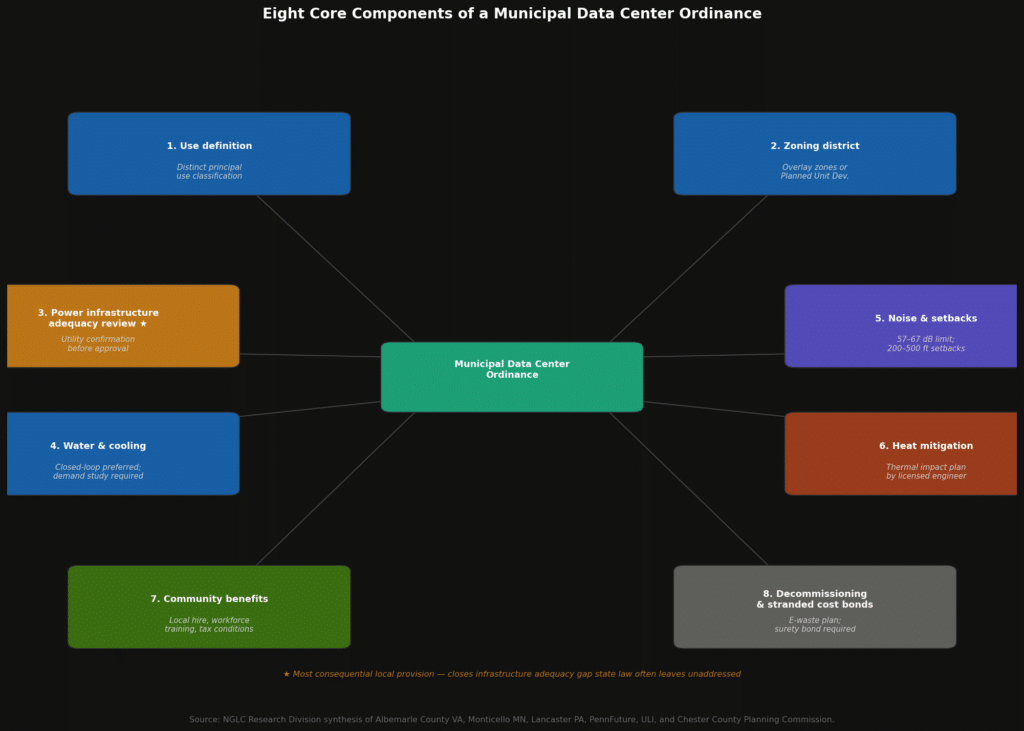
Based on a review of enacted and proposed ordinances across Albemarle County (Virginia), Monticello (Minnesota), Lancaster (Pennsylvania), West Pennsboro Township (Pennsylvania), Limerick Township (Pennsylvania), and model ordinance guidance from PennFuture, the Urban Land Institute, and the Chester County Planning Commission, the following components represent best practices for municipal data center regulation.
Use Definition and Classification. A data center ordinance must begin by clearly defining its subject. Without a specific definition, a facility that houses “computer systems and related infrastructure” may be classified as light industrial, office, or even — in a memorable early zoning misapplication — agricultural. Municipalities should define data centers as a distinct principal use, separate from accessory server rooms that support a building’s primary function. Modular and micro data centers warrant separate accessory use treatment. The distinction between a large-scale commercial data center and a small on-premises server room has significant implications for every other regulatory provision in the ordinance.
Zoning District Structure. Municipalities should direct data centers toward appropriate locations through purpose-built zoning mechanisms. The two dominant approaches are overlay districts — a special zone superimposed on the existing zoning map that permits data centers only where adequate infrastructure exists — and floating zones or Planned Unit Development designations that require project-specific rezoning by the governing body before any data center can proceed. Albemarle County’s tiered structure, which permits data centers up to 125,000 square feet “by right” in Tier 1 areas but requires a special use permit for larger facilities, illustrates how size thresholds can calibrate the level of scrutiny to the scale of impact. Monticello, Minnesota has proposed a Data Center Planned Unit Development (DCPUD) designation requiring full City Council approval for any rezoning, ensuring elected officials review every significant project.
Power Infrastructure Adequacy Review. This is the single most consequential provision available to municipalities in the current environment. A strong ordinance should require any data center applicant to demonstrate, before receiving land use approval, that the electrical utility serving the area has studied the project’s power demand and confirmed that adequate infrastructure and generation capacity are available to serve it without overburdening the existing system or limiting power availability for existing residents and future growth. The municipality should retain authority to deny a project if infrastructure is inadequate or if the development would strain the local power system. In Pennsylvania, state law already requires large power users to pay for infrastructure upgrades needed to interconnect — a municipality can reinforce this by making compliance with that requirement a condition of local approval and requiring evidence of utility confirmation before any permits are issued.
Water Demand and Cooling System Review. Data centers use water — sometimes vast quantities of it. Some hyperscale facilities employ evaporative cooling systems that consume millions of gallons per day. Ordinances should require developers to submit detailed water studies documenting raw water needs, proposed cooling systems, and how they would pay for any new water infrastructure. Closed-loop or recycled water cooling systems should be preferred or required where technically feasible. Municipalities should retain authority to deny projects that would compromise water availability for existing residents or future development.
Noise Standards and Mechanical Equipment Setbacks. Cooling systems, backup generators, and electrical infrastructure generate continuous noise that can significantly affect adjacent residential areas. Best-practice ordinances establish quantified noise standards — typically 57–67 decibels as measured at the property line, with separate daytime (7 am–10 pm) and nighttime (10 pm–7 am) standards. Mechanical equipment should be set back 200–500 feet from residential areas depending on screening, with requirements for berms, landscaping buffers, and sound-attenuating enclosures. Ground-mounted equipment should be fully enclosed where technically feasible; rooftop equipment should be screened by parapet walls or equipment penthouses. Lighting spillover to adjacent residential property should be prohibited, with zero footcandles at property lines adjacent to residential zones.
Heat Mitigation and Urban Heat Island Management. Data centers generate substantial waste heat that, in concentrated development areas, can materially affect ambient temperatures in surrounding neighborhoods. Ordinances should require a Thermal Impact Mitigation Plan, prepared and certified by a professional engineer, that includes strategies for waste heat reuse or dissipation and vegetative or green roof design to offset urban heat island effects.
Community Benefit Agreements and Local Hire. A well-designed ordinance can require data centers to submit community benefit plans addressing local hire commitments, workforce training programs, and investment in community infrastructure. While data centers create relatively few permanent jobs — one study by Food & Water Watch estimated as few as 23,000 people nationally worked in the data center industry as of late 2024 — they can generate significant construction employment and tax revenue. Conditions tied to those benefits ensure they actually materialize.
Decommissioning and E-Waste Plans. Data centers require hardware refresh cycles and are occasionally abandoned when technology changes or operators exit the market. An ordinance should require applicants to submit, as part of the approval process, a decommissioning plan that describes procedures for safe removal, recycling, and disposal of server infrastructure, batteries, and hazardous materials. The municipality should retain the right to require supplemental or amended plans prior to zoning approval.
Stranded Infrastructure Protection. Perhaps the most important financial protection a municipality can require — short of rate-setting authority — is a condition that data center developers demonstrate financial responsibility for infrastructure costs if a planned facility is never completed or does not reach its projected load. This mirrors the stranded-cost provisions in state-level legislation like Pennsylvania’s PPL rate case settlement and Oregon’s POWER Act. A municipality can require developers to post surety bonds or other financial assurance as a condition of approval, protecting the local community and utility from being left with unused infrastructure costs.
6.3 Energy Infrastructure Provisions: The Most Critical Local Tool
Of all the provisions available to municipalities, the energy infrastructure adequacy review deserves particular emphasis because it operates in the gap where state law most commonly falls short. State public utility commissions review interconnection requests and rate cases, but their review processes were designed for a regulatory environment where large-load growth was gradual and incremental. They are not well-designed to give communities advance warning about power system stress or to create local accountability for infrastructure decisions made in state-level proceedings.
A municipal ordinance that requires, as a precondition of land use approval, a written utility determination that adequate power supply exists and that infrastructure costs attributable to the new facility will be borne by the applicant — not socialized across the rate base — creates a local enforcement checkpoint that state proceedings often lack. West Pennsboro Township, Pennsylvania adopted an ordinance in August 2025 requiring applicants to provide confirmation from the electricity supplier that the power system can adequately serve the proposed data center before any permits are issued. This approach does not override state authority; it creates a parallel local requirement that developers must satisfy before receiving local approvals.
Municipalities should also carefully track the relationship between their zoning approvals and utility interconnection requests. In several documented cases, data center developers have obtained local zoning approvals and then submitted interconnection requests that, when processed by utilities, triggered infrastructure buildouts whose costs were spread to residential ratepayers. The local approval gave implicit legitimacy to the project without any local review of the infrastructure financing implications. Requiring utility infrastructure confirmation before granting approvals closes this gap.
6.4 Real-World Ordinance Models Worth Studying
Albemarle County, Virginia began developing data center-specific regulations in May 2024 after recognizing that its proximity to the Northern Virginia data center market was creating development pressure without adequate local controls. The county’s framework uses a two-tier geographic structure mapped to infrastructure availability, with size thresholds triggering different levels of review. While Albemarle’s process was paused in late 2025 for additional study, the framework it developed — particularly its tiered approach to size and scrutiny — provides a useful model for other jurisdictions.
Monticello, Minnesota has worked through a comprehensive DCPUD ordinance that addresses power infrastructure feasibility, water demand studies, noise standards, setback requirements with perimeter berms and landscaping buffers, lighting limitations, and explicit developer responsibility for infrastructure costs including roads, utilities, and public improvements. The ordinance’s requirement that developers demonstrate utility study confirmation of power availability before any project proceeds directly addresses the infrastructure adequacy gap.
The City of Lancaster, Pennsylvania released a draft data center zoning ordinance in October 2025 that includes noise standards, a Thermal Impact Mitigation Plan requirement, a decommissioning and e-waste management plan, and a minimum 50-foot buffer yard along property lines adjacent to residential zones. Lancaster’s ordinance represents one of the more comprehensive draft frameworks from a smaller urban municipality and is notable for its heat mitigation provisions.
At the model ordinance level, PennFuture published a data center model zoning ordinance providing suggested provisions addressing water consumption, power consumption, noise, and aesthetic concerns — a practical reference for municipalities that lack the staff capacity to develop ordinances from scratch. The Chester County Planning Commission has published similar planning guidance specifically for Pennsylvania municipalities.
Why This Matters
▸ For the General Public: Every American who pays an electricity bill is participating in a transfer of wealth they did not choose and were not asked about. The structural mechanisms that allow data centers to expand at industrial scale while residential customers absorb a disproportionate share of the infrastructure costs are built into the legal and regulatory framework that governs American utilities. Understanding how those mechanisms work — infrastructure socialization and wholesale market price effects — is the prerequisite for demanding that policymakers fix them. The measures now emerging at the federal, state, and local levels represent genuine opportunities for public engagement, and the communities that engage most actively will receive the strongest protections.
▸ For Government & Policymakers: The legislative and regulatory window for protecting ratepayers from data center cost externalities is open, but it will not stay open indefinitely. Infrastructure is being built now, and the legal and contractual arrangements that govern how its costs are allocated are being established in rate cases and interconnection agreements filed today. Codifying ratepayer protections into statute — rather than relying on voluntary pledges or administrative rules that can be weakened later — is the essential policy priority. Equally important is transparency: standardized, timely, and publicly accessible reporting of data center power consumption, interconnection requests, and associated infrastructure costs is a prerequisite for effective regulatory oversight. Municipalities that have not yet developed data center-specific ordinances face a narrowing window: the projects now in the pipeline will arrive regardless of whether local frameworks are ready to receive them.
▸ For Customers & Investors: The geography of data center development is not uniform, and neither is its financial impact. Investors and businesses evaluating sites in data center-dense markets should account for electricity cost trajectories that may be materially different from national averages. States and localities that have enacted strong ratepayer protection frameworks — Oregon, Texas, Pennsylvania, Georgia — offer more predictable electricity cost environments for non-data-center businesses and residents than those where cost allocation remains unresolved. For NGLC customers, this analysis reinforces the value of powered land that has been acquired and entitled with explicit attention to power infrastructure planning: the capacity and cost terms associated with a given parcel’s grid connection are becoming critical factors in total project economics, not peripheral concerns.
Key Takeaways
American residential electricity prices increased 27 percent between 2019 and 2025, rising to an average of 19 cents per kilowatt-hour — while large industrial users, including data centers, continued to pay dramatically lower rates. The data center construction boom is not the only cause of rising electricity costs, but it is a primary driver of the infrastructure investment cycle that utilities are monetizing through rate increases, and the cost allocation structures that determine who pays are deeply inequitable. Utilities requested a record $31 billion in rate increases in 2025, more than double 2024’s requests; the Edison Electric Institute projects $1.1 trillion in member utility capital spending from 2025 through 2029.
Two mechanisms transfer data center costs to households: the century-old practice of socializing utility infrastructure costs across all ratepayers, and the market price effects of adding enormous, constant electricity demand in grid regions where supply cannot respond quickly. In the PJM Interconnection region — covering 13 states and the District of Columbia — residential and commercial customers paid $4.4 billion in data center-related transmission costs in 2024.
The federal Ratepayer Protection Pledge signed March 4, 2026, represents a meaningful political signal but carries no enforcement mechanism, covers only seven signatories, and does not bind utilities. State-level legislation — from Texas SB 6 to Oregon’s POWER Act to Pennsylvania’s PPL rate case settlement — provides more durable protection, but implementation is uneven and utilities have already shown a capacity for creative compliance. More than 300 data center bills were introduced in 30-plus states in the first six weeks of 2026, reflecting the breadth of political concern but also the absence of a settled framework.
Municipalities possess meaningful authority to protect their communities through data center ordinances, even without rate-setting authority. The most consequential local tool is the energy infrastructure adequacy review — a requirement that developers demonstrate, before receiving local approval, that adequate power supply exists and that infrastructure costs attributable to the facility will not be socialized to residential ratepayers. Paired with noise standards, water demand review, thermal mitigation requirements, community benefit conditions, and decommissioning plans, a comprehensive local ordinance can address the environmental, infrastructure, and community impacts that state legislation often leaves unaddressed.
The communities best positioned in the current environment are those that engage the regulatory process actively, demand transparency from utilities and data center developers, and enact local frameworks before development pressure arrives rather than after it. Powered land — parcels with well-planned, appropriately priced grid connections — will carry a significant premium in a market where electricity infrastructure costs and conditions are becoming critical project economics variables rather than assumptions.
Sources
- Brookings Institution — “Confronting and addressing rising energy bills linked to data centers” — https://www.brookings.edu/articles/confronting-and-addressing-rising-energy-bills-linked-to-data-centers/
- Environmental and Energy Study Institute (EESI) — “Data Center Power Demands Are Contributing to Higher Energy Bills” — https://www.eesi.org/articles/view/data-center-power-demands-are-contributing-to-higher-energy-bills
- Yale Climate Connections — “Home electricity bills are skyrocketing. For data centers, not so much.” — https://yaleclimateconnections.org/2026/01/home-electricity-bills-are-skyrocketing-for-data-centers-not-so-much/
- Bloomberg News — “AI Data Centers Are Sending Power Bills Soaring” — https://www.bloomberg.com/graphics/2025-ai-data-centers-electricity-prices/
- U.S. Congressman Mike Levin — “Rep. Mike Levin Introduces New Bill to Stop Data Centers from Driving Up Electricity Prices for Consumers” — https://levin.house.gov/media/press-releases/rep-mike-levin-introduces-new-bill-to-stop-data-centers-from-driving-up-electricity-prices-for-consumers
- Fortune — “Your utility bills keep going up. Here’s everyone you can blame — AI data centers included” — https://fortune.com/2026/03/01/utility-bills-keep-rising-everyone-blame-ai-data-centers-included/
- WHYY / Pennsylvania Public Radio — “Pa. electric utility agrees to data center protections for ratepayers” — https://whyy.org/articles/pennsylvania-electricity-costs-data-centers/
- Stateline — “With electricity bills rising, some states consider new data center laws” — https://stateline.org/2026/02/05/with-electricity-bills-rising-some-states-consider-new-data-center-laws/
- Harvard Law School — “How data centers may lead to higher electricity bills” — https://hls.harvard.edu/today/how-data-centers-may-lead-to-higher-electricity-bills/
- Consumer Reports — “AI Data Centers: Big Tech’s Impact on Electric Bills, Water, and More” — https://www.consumerreports.org/data-centers/ai-data-centers-impact-on-electric-bills-water-and-more-a1040338678/
- National Caucus of Environmental Legislators (NCEL) — “States Act to Align Data Center Energy Demand with Climate Goals” — http://ncel.net/articles/states-act-to-align-data-center-energy-demand-with-climate-goals/
- MultiState — “State Data Center Legislation in 2026 Tackles Energy and Tax Issues” — https://www.multistate.us/insider/2026/2/20/state-data-center-legislation-in-2026-tackles-energy-and-tax-issues
- Clean Energy Transition Institute — “Oregon’s POWER Act Addresses Ratepayer Impact of Large Energy Users” — https://www.cleanenergytransition.org/post/oregons-power-act-addresses-ratepayer-impact-of-large-energy-users
- Vermont Journal of Environmental Law — “Data Centers are Increasing Utility Rates — What are States Doing About it?” — https://vjel.vermontlaw.edu/news/2026/03/data-centers-are-increasing-utility-rates-what-are-states-doing-about-it/
- Latitude Media — “State lawmakers stand between ratepayers and data center costs” — https://www.latitudemedia.com/news/state-lawmakers-stand-between-ratepayers-and-data-center-costs/
- White House — “Ratepayer Protection Pledge” — https://www.whitehouse.gov/articles/2026/03/ratepayer-protection-pledge/
- White House — “Fact Sheet: President Donald J. Trump Advances Energy Affordability with the Ratepayer Protection Pledge” — https://www.whitehouse.gov/fact-sheets/2026/03/fact-sheet-president-donald-j-trump-advances-energy-affordability-with-the-ratepayer-protection-pledge/
- Inside Climate News — “Big Tech Signs Trump Pledge to Pay Data-Center Power Costs. Fulfilling It Is the Hard Part.” — https://insideclimatenews.org/news/04032026/trump-data-center-power-costs-pledge/
- Mayer Brown — “Trump Administration Issues Legislative Recommendations for a Federal Artificial Intelligence Framework” — https://www.mayerbrown.com/en/insights/publications/2026/03/trump-administration-issues-legislative-recommendations-for-a-federal-artificial-intelligence-framework/
- Engage Albemarle — “Data Center Regulations” — https://engage.albemarle.org/data-center-regulations
- Monticello Times / Hometown Source — “A guide to Monticello’s proposed data center ordinance” — https://www.hometownsource.com/monticello_times/a-guide-to-monticello-s-proposed-data-center-ordinance/article_6c253088-cf5f-47cc-b952-35e49601cf1e.html
- City of Lancaster, PA — “Data Center Zoning Ordinance, First Draft, October 2025” — https://www.cityoflancasterpa.gov/wp-content/uploads/2025/10/Data-Center-Zoning-Ordinance_First-Draft_10-6-25.pdf
- GovTech — “Data Center Growth Driving Locals to Push for More Say” — https://www.govtech.com/policy/data-center-growth-driving-locals-to-push-for-more-say
- Pottstown Mercury — “Model data center zoning ordinances coming to the fore” — https://www.pottsmerc.com/2026/03/23/model-data-center-zoning-ordinances-coming-to-the-fore/
- LightBox — “Zoning and Land Use Considerations for Data Centers” — https://www.lightboxre.com/insight/zoning-and-land-use-considerations-for-data-centers/
- National Law Review — “State Rules Shaping United States Data Center Projects” — https://natlawreview.com/article/navigating-state-legislation-building-and-operating-data-centers-key-trends-and
- Urban Land Institute — “Local Guidelines for Data Center Development” — https://knowledge.uli.org/-/media/files/research-reports/2024/uli-data-center-whitepaper_hm_2024-11-12_final-final-round.pdf
- Clearfield County Planning Department — “Planning for Data Centers” — https://clearfieldcountypa.gov/DocumentCenter/View/745/7-Data-Centers-PDF
- Oregon Senate Democrats — “Regular Electricity Consumers Won’t Pay For Big Tech’s Utility Costs Under Bill Advanced by Oregon Senate” — https://www.oregonlegislature.gov/senatedemocrats/Documents/Regular%20Electricity%20Consumers%20Won%E2%80%99t%20Pay%20For%20Big%20Tech%E2%80%99s%20Utility%20Costs%20Under%20Bill%20Advanced%20by%20Oregon%20Senate.pdf
- Cronkite News — “Trump’s tech giants pledge to shield ratepayers doesn’t cover biggest Arizona data center projects” — https://cronkitenews.azpbs.org/2026/03/06/trump-ratepayer-pledge-data-centers-arizona/
Ready to Move?
Whether you're a developer evaluating sites, a landowner with acreage, or a community leader with questions — we respond within one business day.